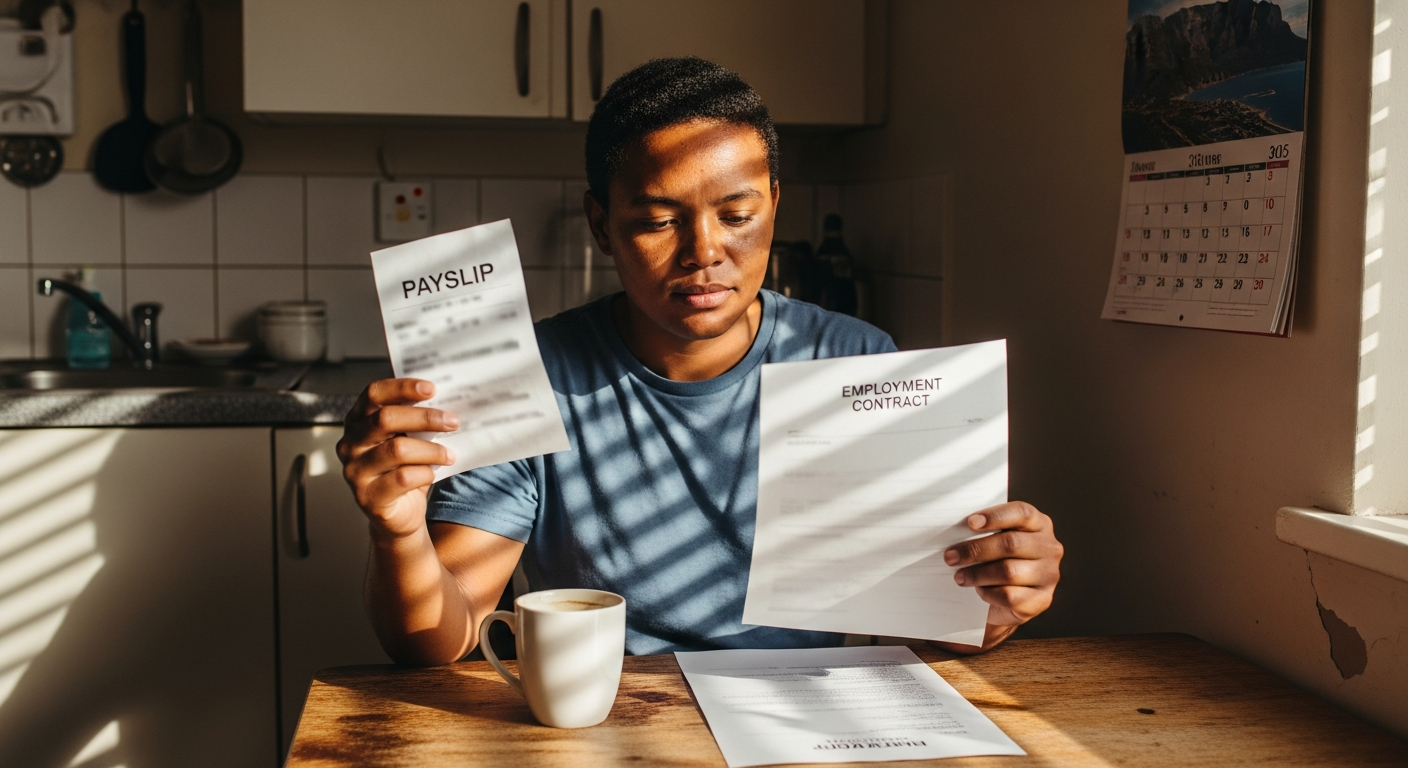
Probation is the most misunderstood part of a South African employment contract. Most jobseekers assume "I'm on probation" means "they can let me go for any reason, no questions asked". Most first-time employers assume the same thing in reverse — that probation is a free-fire zone where they can dismiss you on a whim. Both are wrong, and the CCMA hears arbitrations about it every week.
This guide is the practical version of your rights in the first three months of a new job in South Africa in 2026. What BCEA actually says, what the Code of Good Practice expects from your employer, and what your moves are if it goes sideways. Open the For Jobseekers hub → for more rights and application guides, or come back to this once you have an offer in hand.
What probation legally is in South Africa
Probation is a defined, time-bound period at the start of employment during which the employer assesses your suitability for the role. It's covered indirectly by the BCEA (which gives you all your standard employee rights from day one) and directly by Schedule 8 of the Labour Relations Act — the Code of Good Practice on Dismissal. Item 8 of the Code spells out specifically how probation must be handled.
The key principle: probation lowers the procedural bar slightly, not the fairness bar. Your employer still has to act fairly, give you reasons, give you a chance to improve, and document the conversation before terminating. They cannot simply say "it's not working out" and put you out the door.
What your rights actually are from day one
Many of the rights you might assume kick in after probation actually kick in on day one:
- Written particulars of employment (BCEA s29) — must be handed to you by day one. Your contract.
- Written payslip every payday (BCEA s33) — even on probation, even if you're only there for two weeks.
- UIF registration within 30 days of start if you work more than 24 hours/month. Your employer's legal responsibility.
- Paid annual leave accrues from day one — 1.25 days per month worked.
- Paid sick leave — 1 day for every 26 days worked in the first 6 months; full sick-leave cycle thereafter.
- Family responsibility leave after 4 months — 3 days/year for the death of a close family member, birth of a child or sick child.
- Public holidays paid from day one when they fall on a working day.
- Minimum wage protection from day one — R30.23/hour in 2026, no exceptions for "trainees" or "probationers".
- Safe working conditions — full OHS Act and COIDA cover from day one.
Notice the pattern: nearly everything that protects a permanent employee also protects a probationer. The only meaningful difference is the lower procedural bar for dismissal (more on this below) and a shorter notice period.
How long can probation be?
There's no specific maximum in the BCEA. The Code of Good Practice treats "a reasonable period determined with reference to the nature of the job" as the test. In practice:
| Role type | Reasonable probation | Defensible upper limit |
|---|---|---|
| Entry-level (cashier, agent, guard, driver) | 1–3 months | 3 months |
| Supervisor / team leader | 3 months | 6 months |
| Skilled professional (bookkeeper, developer) | 3 months | 6 months |
| Senior management / specialist | 3–6 months | 12 months (rare; needs strong justification) |
If your contract says 6 months for a cashier role, that's a red flag — not necessarily illegal, but pushing it. If the employer wants to extend probation at month three, they need a clear, written reason and a clear set of performance improvements they need to see. "We need more time" without specifics is not enough.
Notice periods during probation
Under BCEA s37, notice periods are based on length of service, not on probation status:
- 0–6 months service: one week's notice either way.
- 6–12 months service: two weeks' notice.
- Over 12 months: four weeks' notice.
So if you're dismissed (or resign) at week 8, you're entitled to one week's notice or pay in lieu. Sectoral determinations (farm workers, domestic workers, contract cleaning) sometimes specify slightly different rules — check your specific contract.
Dismissal during probation — what's actually required
This is the part employers most often get wrong. To lawfully dismiss you during probation for performance reasons, the employer must (per item 8 of Schedule 8):
- Have a real reason based on inability to do the job, not just personal preference or rumour.
- Tell you what the standard is and how you're falling short — preferably in writing, in good time.
- Give you a reasonable opportunity to improve — coaching, training, support, time.
- Hold a meeting before the dismissal decision is taken, where you have a chance to respond.
- Notify you in writing of the dismissal, with reasons.
If they skip steps — particularly the chance to improve and the meeting — the dismissal is procedurally unfair, and the CCMA can reinstate you or order compensation up to 12 months' salary in cases where reinstatement isn't practical.
For misconduct (e.g. theft, gross insubordination, fighting on duty), the standard rises to roughly the same as for a permanent employee — proper investigation, hearing, right to representation.
The first three weeks — what to actually check
Use this checklist in your first 21 days. Each one is a five-minute job that protects you for years.
- Day 1: received written contract; signed and kept a copy.
- Day 1: shown the disciplinary code and BCEA summary poster.
- Day 1: photographed your contract on your phone and emailed it to yourself.
- Week 1: received first time sheet or roster in writing; understand the shift pattern.
- Week 2: confirmed in writing what success looks like at end of probation.
- Week 3: first payslip received; checked: hours, gross, PAYE, UIF, net.
- Week 3: confirmed UIF deduction with employer; have copy of UI-19 declaration if possible.
- Ongoing: WhatsApp records of work-related conversations kept; nothing deleted.
If any of these are missing — particularly the contract, the payslip and the UIF deduction — raise it once in writing with your supervisor. If nothing changes within a fortnight, escalate to HR or to the Department of Employment and Labour walk-in centre on Long Street in Cape Town.
Salary and benefits during probation
You're entitled to the salary and benefits specified in your contract from day one. Employers cannot pay you below your contracted rate "until probation is confirmed". That's wage theft, full stop.
If your contract specified medical aid contribution, transport allowance, or shift allowances, those kick in immediately unless the contract explicitly says "after confirmation of permanent appointment" (which is allowed but should be flagged before signing). If you accepted a salary you now think is too low, see our salary negotiation guide — the probation review meeting is a defensible second negotiation moment.
What to do if you suspect unfair treatment during probation
- Write it down. A short, factual timeline of what happened, with dates. Keeps your memory honest and is essential for any later case.
- Raise it once in writing with your line manager. Email or formal WhatsApp. "I'm concerned about X. Can we discuss this week?" gives the employer a chance to fix it and creates a paper trail.
- If unresolved, escalate to HR (if there is one) or the next level of management.
- If still unresolved or you're dismissed, refer to the CCMA within 30 days of dismissal. The form is LRA 7.11 — available free at any CCMA office or online.
- Bring: your contract, every payslip you received, any warning letters or emails, the written timeline you started in step 1, and two copies of everything.
The CCMA process starts with conciliation — a 60–90 minute meeting where a commissioner tries to settle the matter. It's free, informal, no lawyers required. About 60% of cases settle here. If it doesn't settle, you go to arbitration, which is more formal but still free for the employee for individual dismissal disputes.
What constitutes a "fair" probation dismissal at the CCMA
From the case law over the last decade, the CCMA tends to find probation dismissals fair when:
- The performance standard was clearly communicated in writing within the first month.
- Specific shortfalls were raised with the employee at least once before the final meeting.
- The employee was given practical support (training, mentoring, paired shifts) to improve.
- The final meeting actually happened, with notes kept and the employee given the right to respond.
- The decision was communicated in writing with reasons.
Cases tend to go the other way (employer loses) when: no written warning, no meeting, vague "fit" reasons rather than performance reasons, or dismissal that coincides suspiciously with the employee raising a UIF or wage issue.
Resignation during probation
You can resign during probation with the contractual notice period (usually one week in the first six months). Hand the resignation in writing — a short, dated WhatsApp or email is fine, and our resignation letter template has wording you can copy. The employer must pay any accrued leave at termination and issue a UI-19 with the correct termination code so you can claim UIF if needed.
If you're resigning because the role isn't what was advertised, keep a copy of the original ad and your contract — useful if you later need to claim constructive dismissal at the CCMA. Constructive dismissal cases are hard to win, but real, and starting the file early matters.
The mindset shift
Most South African employees go into probation feeling powerless. The legal reality is closer to the opposite — you have nearly the full bundle of employee rights from day one, and a procedurally tight CCMA system that takes probation disputes seriously. The employer has the burden of proving fairness, not you.
That doesn't mean you should walk in adversarial. The best probation outcomes come from doing the job well, asking for written feedback, and treating the first three months as a two-way evaluation. But know the floor — and know how to use the CCMA if you ever need to. For the broader employment journey, our salary negotiation guide covers the probation-confirmation review specifically, and our domestic worker application guide covers a sector where probation issues come up most often.
Keep your contract, check your payslips, document everything, and stay calm. Browse Cape Town jobs → or jump straight to the admin and office category if you're between roles, and treat the next probation period as the structured, fair process it's legally meant to be.
Or head back to the For Jobseekers hub → for the rest of our guides on CVs, interviews, salary scripts and avoiding scams.