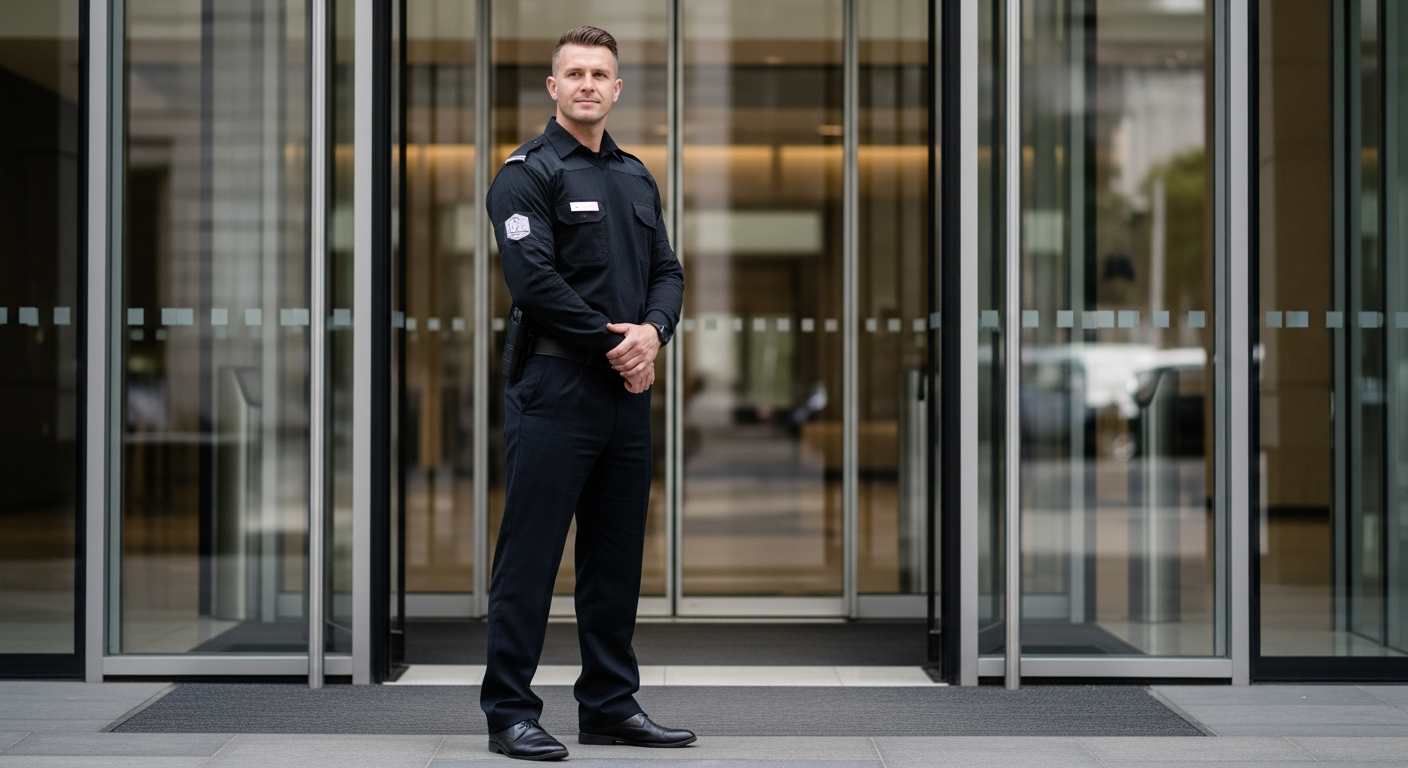
Security is the line item most Cape Town businesses don't want to think about until they have to. A break-in at the office in Salt River, a cash-in-transit incident at the Bellville branch, a tenant complaining about loitering at the Sea Point block — and suddenly you're shopping for guards in a hurry. That's exactly when you make a bad decision.
This guide is the calm version. Two paths to choose from, the PSIRA rules you can't shortcut, what guards actually cost in 2026, and the questions that separate a serious provider from a printed-uniform operation.
If you already know the route you want, post a job in Cape Town → and start screening guards or supervisors directly.
Two routes: security company or hire your own
Most Cape Town employers go with a security company. Estates, shopping centres, body corporates, office parks, schools — almost all outsource. The contract bundles guards, supervision, armed response, control room monitoring and insurance into one monthly fee, and the headache of recruitment, training and PSIRA compliance sits with the provider.
Hiring your own guards directly only really makes sense if you're large enough to run an in-house security function: a big gated estate with a permanent gatehouse, a national retailer with a regional loss-prevention team, a logistics yard in Epping that needs guards integrated with operations. You take on PSIRA registration as a security service provider, you do the vetting, you handle disciplinary processes, and you carry the COIDA risk.
Neither path is wrong. The right one depends on scale, control, and how much security work is core to what you do.
PSIRA: non-negotiable for both routes
Under the Private Security Industry Regulation Act, every guard must be registered with the Private Security Industry Regulatory Authority (PSIRA). Every company employing or providing guards must also be registered. There is no grey area, no "we're only doing it for a month" exception.
Verify before you contract. Go to psira.co.za, click the verification tool, and check both the company's registration number and each guard's individual number. A legitimate provider will give you these without hesitation. If someone gets defensive or says "we'll send it tomorrow", that's your answer.
An unregistered guard is not just a paperwork issue. It voids your insurance, it's a criminal offence under the Act, and if anything happens on shift you carry the full liability personally.
PSIRA grades — what each one actually does
Grades run from E (entry-level) up to A (most senior). Each requires accredited training and a written exam.
- Grade E — Basic site guarding. Static post, observation, reporting incidents. The starting point for most guards.
- Grade D — Access control, patrolling, more complex sites. The bulk of guarding work.
- Grade C — Site supervisor. Manages a small team, reports to area manager, handles shift handovers and incident escalation.
- Grade B — Senior supervisor or team leader. Complex sites, multiple guards, often armed.
- Grade A — Management. Security managers, operations managers, senior armed response. Highest pay and the most regulatory accountability.
You don't need a Grade A on every post. Matching the grade to the risk profile of the site is the whole game. A daytime reception desk in a Foreshore office doesn't need a Grade B — a well-trained Grade D with a competent Grade C supervisor doing rounds is the right answer.
2026 minimum wages — Sectoral Determination 6
Security is regulated by Sectoral Determination 6, not the standard national minimum wage. It's split into Area A (Cape Town metro, Johannesburg, Tshwane, Ekurhuleni, eThekwini) and Area B/C (the rest of the country including most of the Western Cape outside the main metropolitan boundaries).
For 2026, the monthly minimums for Area B/C on a 48-hour week look roughly like this:
| Grade | Area B/C monthly minimum (48-hr week) |
|---|---|
| Grade E | ~R5,558 |
| Grade D | ~R6,054 |
| Grade C | ~R6,584 |
| Grade B | ~R7,250 |
| Grade A | ~R7,920 |
Area A rates (full Cape Town metro) are higher. These are the legal floor — established providers pay above this, particularly for armed grades, supervisors, and anyone working high-risk posts. Sleep-out allowances, night shift premiums and Sunday work are extra on top.
Don't try to push under these numbers. The CCMA and Department of Employment and Labour both take Sectoral Determination 6 underpayment seriously, and the back-pay orders run for years. Our hiring costs in South Africa guide goes into UIF, SDL and COIDA on top of base.
What a guarding company actually charges
For a single 24/7 post in Cape Town — one position covered round the clock — expect to pay between R28,000 and R45,000 per month from a reputable provider. That sounds steep until you do the maths.
168 hours a week of coverage with 12-hour shifts means two to three guards rotating, depending on how leave and absence are managed. Each of those guards is on at least the Grade D minimum, plus night-shift premium, plus the company's own overheads: uniforms and PPE (R2,000+ per guard at kit-out), training and refresher courses, supervision (an area manager physically visiting the post weekly), control room monitoring, armed response standby, public liability insurance, and the company's margin.
Armed posts cost more — typically R35,000 to R55,000 per month — because the guard's grade is higher, the firearm and ammunition are an ongoing cost, and the insurance loading is significant. K9 units run R20,000+ per month on top of the standard post for the dog, handler, and vet costs. Control room monitoring with offsite verification is usually billed per panic activation or as a flat monthly tariff (R150–R400 per address).
COIDA and the on-cost reality
The Compensation for Occupational Injuries and Diseases Act assessment for security companies is in the 2–3% range — meaningfully higher than the ~0.42% you'd pay for an office. That's because security work is genuinely riskier and the COIDA Commissioner prices it accordingly. If you're hiring your own guards, build that into your payroll forecast. Outsource and it's the provider's problem (and is already priced into their monthly fee).
UIF (1% + 1% = 2%) and SDL (1% if your payroll is over R500,000 a year) apply as normal.
Questions to ask a security provider
Anyone can print a uniform and call themselves a security company. The serious providers answer these without flinching:
- PSIRA company registration certificate? See the actual document and verify the number on psira.co.za. Check it hasn't lapsed.
- Public liability insurance? Ask for the cover note. Minimum R10 million is reasonable for commercial work; bigger sites should expect R25 million plus.
- SLA with response times? Armed response should commit to a target time (8–15 minutes is typical in Cape Town suburbs; faster on the Atlantic Seaboard where the route is shorter) with consequences if missed.
- Supervision schedule? How often does a supervisor physically inspect the post? Daily, weekly, monthly? Are visits logged and signed by the guard on duty?
- Body cams and patrol monitoring? Body cams are becoming the norm — they protect the guard, your business, and the company. Patrol monitoring tags (the buttons guards scan on rounds) prove the patrol actually happened.
- Vetting policy? What do they check before deploying a guard to your site? Criminal record, PSIRA standing, drug screening, prior disciplinary history?
- Staff turnover rate? High turnover means new faces every month — bad for site knowledge, bad for security. A company that knows its numbers and shares them is doing the work.
Get the answers in writing before you sign the SLA. If the rate looks 30% below the rest of the market, ask which of the above corners have been cut. Usually it's the wage paid to the guard.
If you're hiring guards directly
The same vetting applies, and you also need to register as a security service provider yourself. Write a clear job ad with the grade required, the shift pattern, the post location, and the wage — our job advert examples for South Africa shows the structure that works for security roles. Then post it to the right audience.
The fastest place to reach active guards and supervisors in Cape Town is the security category on Cape Town Jobs. Compare what a single post versus a recruiter subscription costs on the pricing page, and have a look at how other operators present themselves on the Cape Town Jobs employers page before you write your ad.
Post a security job in Cape Town → and screen PSIRA-registered guards within 24 hours.