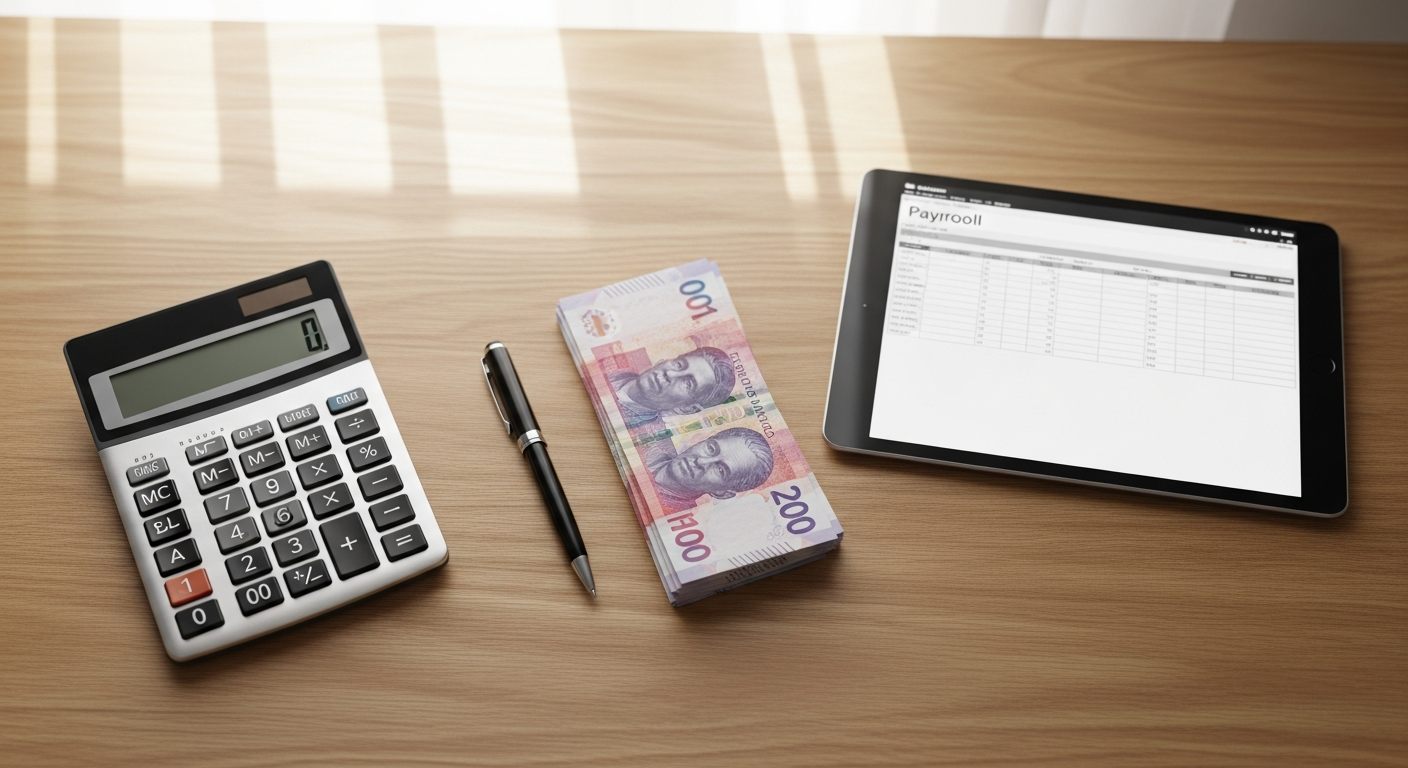
Here's the thing every first-time employer in Cape Town learns the hard way: the gross salary on the offer letter is not what the hire costs you. Not even close. By the time you add statutory contributions, accrued leave, a possible 13th cheque and the once-off cost of actually finding the person, a R10,000 hire usually sits between R10,800 and R11,300 a month on your books — and that's before you've spent a cent on a desk, a laptop or training.
If you're budgeting for your first hire, or trying to work out whether you can afford a second one, you need the full picture. Let's go line by line so there are no surprises when SARS, the Compensation Commissioner or the DEL come knocking. Already have the offer ready? Post a job in Cape Town → and we'll come back to the maths.
UIF: the small one everyone gets right
The Unemployment Insurance Fund is the easy one. Both you and the employee contribute 1% of remuneration, capped at a ceiling of R17,712 per month. That means the maximum either side ever pays is R177.12 a month. On a R10,000 salary you'd deduct R100 from the employee and pay R100 yourself — R200 total to UIF each month.
UIF applies to almost everyone who works more than 24 hours a month for you. Domestic workers, gardeners, part-time bookkeepers, casual shop assistants — they're all in. There's no exemption for small businesses. Register through uFiling or SARS eFiling and the contribution comes off your monthly EMP201 return.
SDL: only if your payroll is big enough
Skills Development Levy is 1% of payroll, but it only kicks in once your annual payroll bill exceeds R500,000. For a one-person business hiring their first staff member at R10,000 a month (R120,000 a year), SDL is not yet a concern. Once you've got four or five people on R8,000 to R10,000 each, you cross the threshold and SDL becomes mandatory.
The good news: SDL is partly recoverable. If you register with the relevant SETA and submit a Workplace Skills Plan, you can claim back a chunk as a mandatory grant, and more through discretionary grants if you do learnerships. Most small Cape Town employers leave that money on the table because the admin feels intimidating, but it's genuinely worth a phone call to your SETA once you're paying.
COIDA: the one that depends on what you do
The Compensation for Occupational Injuries and Diseases Act is the one most new employers forget about until they get a letter from the Compensation Fund. You pay an annual assessment based on your total payroll multiplied by an industry-specific rate set by the Compensation Commissioner.
To give you a sense of the spread:
- Admin and office work — roughly 0.42% of annual payroll. On a R120,000-a-year hire that's about R504 a year, or R42/month if you spread it.
- Security — usually in the 2-3% band. A R7,920/month PSIRA Grade A guard works out to roughly R1,900-R2,850 a year per person in COIDA alone.
- Construction — typically 3-5%, occasionally higher for high-risk subclasses. On a R12,000-a-month bricklayer that's R4,300-R7,200 a year.
You declare your payroll once a year by 31 March and the Compensation Fund invoices you. If you don't register, you're still liable when an injury happens — and the penalty is paying the full medical and disability bill out of your own pocket plus a fine. For a roofing accident that runs into hundreds of thousands. Register.
PAYE: not your money, but your responsibility
PAYE is the income tax your employee owes SARS, withheld monthly. On a R10,000 salary you typically don't deduct any PAYE — the first R95,750 a year (under age 65) sits below the tax threshold. Once a hire crosses into the R10,500-R11,000 a month range you'll start deducting modest amounts; by R20,000/month PAYE is meaningful.
Critically: even though PAYE comes out of their pay, the legal responsibility for calculating it, deducting it and paying it across to SARS by the 7th of the following month is yours. Get it wrong and SARS chases you, not the employee. If you've never run a payroll, use SimplePay, Sage Payroll or PaySpace from day one — the R150-R300/month subscription pays for itself the first time you'd otherwise have miscalculated a tax bracket.
Leave accrual: the hidden 6%
Under the BCEA, every employee on a full five-day week earns 21 consecutive days (15 working days) of paid annual leave per leave cycle. That's roughly 6% of the working year that you're paying for but the person isn't physically working. Most employers don't think about it as a cost because it's already inside the salary — but when you compare to a contractor or a piece-rate worker, that 6% is real.
Sick leave (30 working days over a 36-month cycle, so roughly 10 days a year) and family responsibility leave add another small loading. If you want the full statutory picture, our BCEA employer's guide for 2026 walks through every clause that actually bites in practice.
13th cheque: optional, but factor it in if you offer it
A 13th cheque isn't legally required in South Africa. It's contractual. But if you put it in the offer letter, it becomes enforceable, and a lot of Cape Town employers do offer some form of December bonus because the market expects it — particularly in retail, hospitality and admin roles.
If you commit to a full 13th cheque, that's another 8.3% on the annual cost (one extra month out of twelve). A common compromise for SMEs is a half-month bonus or a discretionary performance bonus capped at a percentage of salary. Whatever you decide, write it into the contract clearly so you don't end up at the CCMA arguing about "custom and practice".
Recruitment: the once-off you forgot to budget
Before the first payslip, you've already spent money finding the person. Even a "free" hire through word of mouth costs you time. Realistically, plan on:
- Job advertising — anywhere from free (Gumtree, Facebook) to R1,200-R4,000+ per post on the bigger boards. Cape Town Jobs sits in between — see /pricing for current single-post and package rates.
- CV screening — 5 to 10 hours for a typical role with 30-50 applicants. At a R250/hour internal cost that's R1,250-R2,500.
- Interview hours — three rounds of one-hour interviews with two interviewers is 6 hours of senior time. Another R1,500-R3,000.
- Reference and background checks — R300-R800 if you use a service like MIE or Lexis RefCheck.
- Productivity dip — the new hire is at maybe 40-60% productivity for the first two months. Quietly real, hard to put a rand value on, but worth knowing.
For a basic admin role you can keep this under R3,000 all in. For a niche skilled role using an agency, you're looking at 12-20% of the annual package — R15,000 to R60,000 for a R10,000 to R25,000/month hire.
Onboarding and training
The first week of any new hire is mostly induction: paperwork, system access, introducing them to the team, walking them through the SOPs. Budget at least a day of a manager's time, plus whatever software licences, uniforms, PPE or tools the role needs. For a desk-based admin hire you're at R1,500-R3,000 in setup costs; for a driver or security guard with PPE and equipment, easily double that.
Worked example: a R10,000 admin hire in the CBD
Let's put it all together for a junior admin hire on R10,000 gross, sitting in your Foreshore office. The role's COIDA class is the admin/office one at around 0.42%.
| Cost item | Monthly | Notes |
|---|---|---|
| Gross salary | R10,000 | What appears on the payslip |
| UIF (employer) | R100 | 1% of remuneration |
| SDL | R0 or R100 | Only if your annual payroll > R500k |
| COIDA | ~R42 | 0.42% of payroll, paid annually |
| Leave accrual (loaded) | ~R600 | 15 working days a year |
| 13th cheque accrual (if offered) | ~R833 | One extra month, spread over 12 |
| Monthly all-in | R10,800 – R11,675 | Depending on SDL and bonus |
On top of that, the once-off cost of getting them through the door: roughly R3,000 to R8,000 for a self-serve hire, or R15,000+ if you went via an agency. Spread over a typical two-year tenure that's another R125 to R650 a month effectively.
So the next time you say "we can afford someone on ten grand", what you actually mean is "we can afford R11,000 to R12,000 a month plus a few grand up front". That's the number to put in your cash flow.
What this changes about your hiring decisions
Two practical takeaways. First, the gap between R10,000 and R12,000 gross is much smaller than the loaded cost gap suggests — the statutory percentages stay the same, so paying a bit more to get a better person rarely breaks the budget the way new employers fear. Second, if you're hiring at minimum wage, the loaded cost still adds about 8-13% — there's no "below minimum wage" once you factor in UIF, COIDA and leave.
If you're hiring office staff in the CBD or northern suburbs, browse admin and office jobs already live on the site to benchmark what others are paying. And when you're ready to advertise, our employer hub walks you through the full posting flow.
Post a job in Cape Town → and put a realistic loaded-cost number on the spreadsheet from day one. It's a much less stressful way to grow.