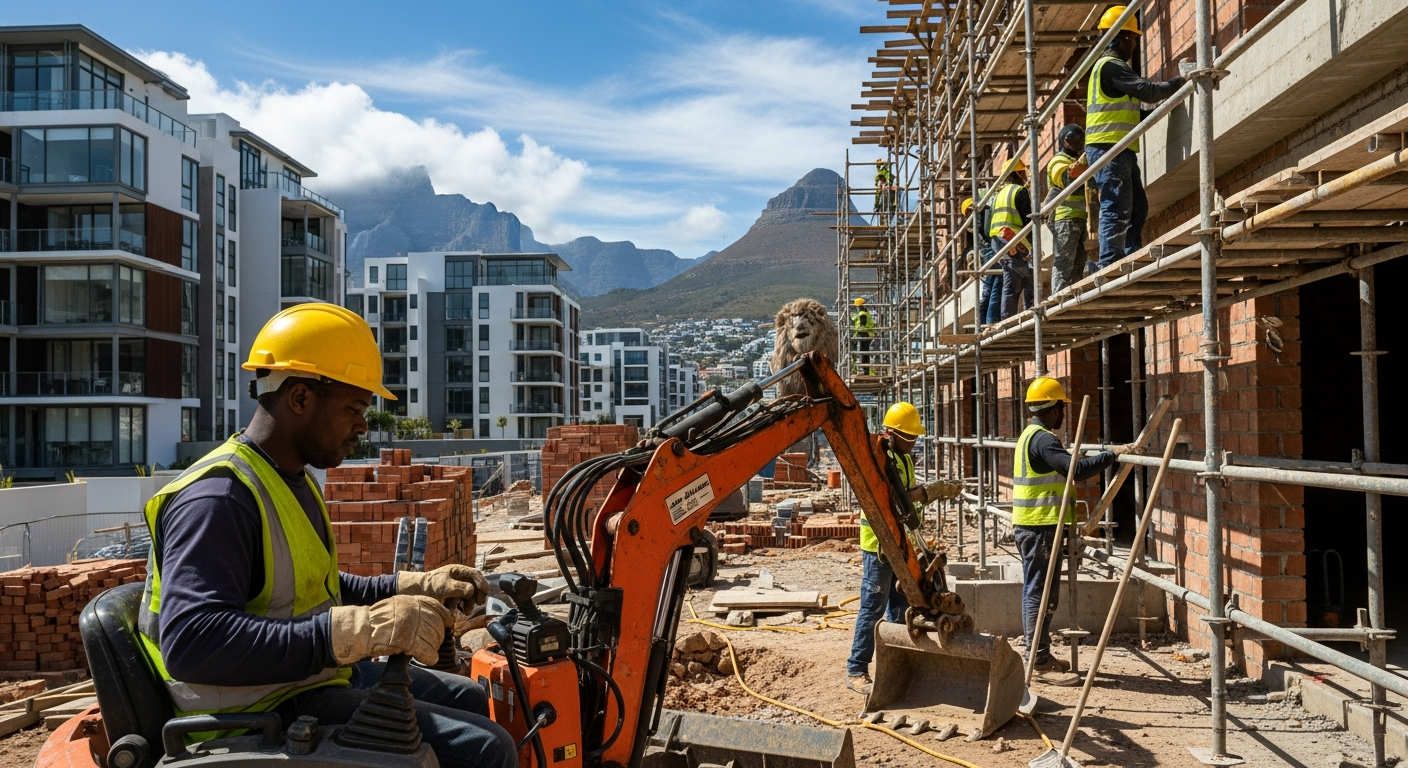
Cape Town's construction industry cycles between boom and slowdown, but even in quieter periods, there's always building happening. New residential developments, infrastructure upgrades, commercial projects, and the endless renovation work in the city's older suburbs create consistent demand for construction workers and tradespeople.
The sector employs people at every skill level — from labourers who carry materials on site to qualified engineers who manage multi-million rand projects. The pay gap between these levels is significant, which is why getting a trade qualification is one of the best investments a young person in Cape Town can make.
Types of construction and trades jobs
General labourer — Entry-level site work: digging, carrying materials, mixing concrete, cleaning up. No qualifications needed, just physical fitness and willingness to work outdoors in all weather. This is where many people start before moving into a trade. Read about other jobs available without matric.
Bricklayer / mason — Building walls, laying bricks, and plastering. Skilled bricklayers are in demand for both new builds and renovations. Some learn on the job; others complete formal training through TVET colleges.
Electrician — Installing and maintaining electrical systems in homes, offices, and industrial buildings. This requires a formal trade qualification and registration. Qualified electricians are always in demand and command strong salaries.
Plumber — Installing and repairing water systems, drainage, and gas fittings. Like electricians, plumbers need a trade test certificate. Cape Town's water infrastructure challenges and new housing developments keep demand high.
Welder and fabricator — Working with metal structures, gates, burglar bars, industrial equipment, and construction steelwork. Welding qualifications range from basic to specialised (coded welding for structural work).
Carpenter / joiner — Building roofs, installing doors and windows, fitting kitchens, and doing finishing work. Skilled carpenters who can handle both structural and finish carpentry are well-paid.
Painter — Interior and exterior painting for residential and commercial projects. Lower barrier to entry than most trades, but experienced painters who can handle specialised finishes earn significantly more.
Tiler — Installing floor and wall tiles in bathrooms, kitchens, and commercial spaces. Good tilers are in high demand, especially for large residential developments.
HVAC technician — Installing and maintaining air conditioning, heating, and ventilation systems. This is a growing specialisation as Cape Town's commercial buildings and data centres expand.
Site foreman / supervisor — Managing the daily operations on a construction site, coordinating workers, ensuring safety compliance, and liaising with project managers. Requires experience and often a construction-related diploma.
Quantity surveyor — Estimating costs, managing budgets, and handling contracts for construction projects. Requires a university degree (BSc Quantity Surveying). One of the highest-paid roles in the industry.
What construction jobs pay in Cape Town
- General labourer — R4,000 to R7,000 per month
- Bricklayer — R5,000 to R10,000 per month
- Painter — R5,000 to R10,000 per month
- Tiler — R5,000 to R12,000 per month
- Carpenter / joiner — R7,000 to R15,000 per month
- Welder — R7,000 to R15,000 per month
- Electrician (qualified) — R10,000 to R25,000 per month
- Plumber (qualified) — R10,000 to R22,000 per month
- HVAC technician — R10,000 to R22,000 per month
- Site foreman — R15,000 to R28,000 per month
- Quantity surveyor — R20,000 to R45,000 per month
- Project manager (construction) — R25,000 to R55,000 per month
Independent tradespeople who run their own businesses can earn significantly more, particularly in the renovation market. A qualified plumber or electrician doing private work in affluent suburbs can charge R350 to R600 per hour. For detailed salary data, see our construction and trades salary guide.
How to get into a trade
The formal route into skilled trades in South Africa follows this path:
Step 1: Find an apprenticeship or learnership — Contact construction companies, maintenance firms, or the relevant SETA (CETA for construction, merSETA for engineering trades) about apprenticeship opportunities. Some companies advertise apprenticeships; others take on apprentices through word of mouth. Our learnerships guide covers how to find these programmes.
Step 2: Complete theoretical training — TVET colleges in Cape Town (Northlink TVET, College of Cape Town, False Bay TVET, South Cape TVET) offer the theoretical component of trade qualifications. Courses run alongside your practical work with an employer.
Step 3: Gain practical experience — Apprenticeships typically last 3-4 years, combining work experience with college training. During this time, you earn a stipend or apprentice wage.
Step 4: Write your trade test — Once you've completed the required hours of practical work and theoretical training, you write a trade test at an accredited trade test centre. Passing this gives you your trade certificate — a nationally recognised qualification.
Step 5: Register with the relevant body — Electricians register with the Department of Employment and Labour and need a wireman's licence. Plumbers register with PIRB (Plumbing Industry Registration Board). These registrations are essential for legal compliance and credibility.
Where construction work is happening in Cape Town
Construction activity shifts with new developments, but current hotspots include:
- Northern suburbs (Brackenfell, Kraaifontein, Durbanville) — Significant new residential development. Brackenfell in particular has seen major housing estate construction.
- CBD and Foreshore — Commercial building upgrades, mixed-use developments, and office refurbishments.
- Century City and Tygervalley — Ongoing commercial and retail expansion.
- Somerset West and Strand — New residential estates and retirement villages.
- Infrastructure projects — Road upgrades, water infrastructure, and public transport improvements across the metro.
- Renovation market — Established suburbs always have renovation and maintenance work. This market is more stable than new construction because homeowners renovate regardless of economic conditions.
Safety on construction sites
Construction is one of the more dangerous industries. Safety regulations exist for a reason:
- Every site must have a health and safety plan and a designated safety officer
- Personal protective equipment (PPE) — hard hats, steel-toe boots, high-visibility vests, gloves — is mandatory
- Working at heights requires fall protection and specific training
- If a site doesn't follow safety procedures, you have the right to refuse unsafe work
The Construction Health and Safety regulations under the OHS Act are clear. Don't work for contractors who cut corners on safety — the consequences aren't worth the pay.
Finding construction work
- Construction companies — Apply directly to firms like WBHO, Murray & Roberts, Stefanutti Stocks, and Group Five (now part of Wilson Bayly Holmes-Ovcon). Smaller local builders also hire regularly.
- Labour brokers — Many construction workers find work through labour brokers, particularly for project-based employment. Companies like Workforce Staffing and Kelly handle construction placements.
- Online listings — Browse construction and trades vacancies on Cape Town Jobs.
- Site walk-ins — Visiting active construction sites with your CV is a common and often effective approach, especially for labourer positions.
- Trade networks — Once you're qualified, word of mouth becomes your best source of work. Build relationships with contractors, property managers, and other tradespeople.
Construction offers genuine career progression and the satisfaction of building something tangible. Whether you're starting as a labourer or already qualified in a trade, Cape Town's construction sector has work. Check the latest vacancies and start applying.